
An oilfield flushing truck quotation should define where the pumped fluid goes after it returns from the well. A pumping unit, return tank, solids separator and water-treatment package serve different functions. Buying the truck does not automatically include a complete closed-loop system, and capturing return water does not by itself make that water suitable for reuse or discharge.
For buyers comparing a well flushing truck for oilfield sand cleanout, the most useful starting point is a supply-boundary drawing. Mark each connection between the truck, wellsite return equipment, storage and any treatment stages. Then identify the supplier or site team responsible for every item and interface.
Define the oilfield flushing truck return-water boundary
Specify the expected return-fluid range rather than assuming it will match the injected water. Ask the wellsite team for information on possible solids, hydrocarbons, chemicals and other constituents relevant to the job. The return rate can also vary during a cleanout, so the receiving arrangement needs a defined design basis and an agreed response to conditions outside that basis.
The well program and site engineering review must establish appropriate well-control, pressure-handling and gas-management arrangements. An ordinary water tank must not be assumed to receive pressurized or gas-bearing returns safely. This article concerns procurement responsibilities; it does not provide a field circulation procedure or specify how to connect a live well.
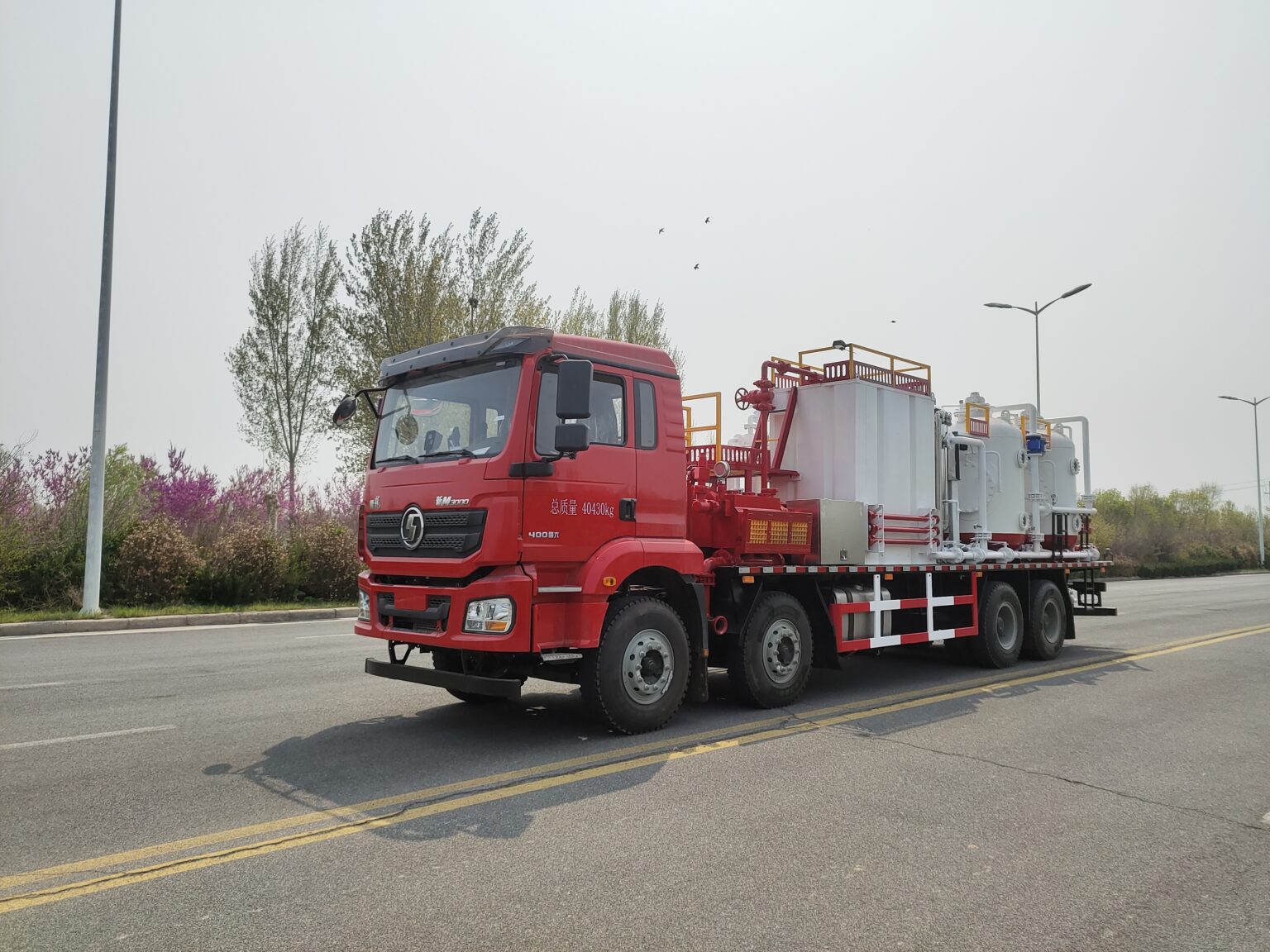
Separate collection, solids removal and water treatment
| Function | What the enquiry should define | What must not be assumed |
|---|---|---|
| Collection and buffering | Return conditions, usable capacity and transfer interfaces. | A collection tank is not a complete treatment process. |
| Solids separation | Particle characteristics, loading range and removal objective. | Removing visible sand does not remove every contaminant. |
| Water conditioning | Feed analysis and the required downstream water quality. | Clear-looking water is not proof of reuse suitability. |
| Residuals handling | Storage, transfer and responsibility for removed material. | Residuals disposal is not automatically included with the truck. |
SLB's solids-management overview emphasizes the importance of understanding solids and the conditions under which they occur. For procurement, that supports a straightforward rule: give the separation supplier the actual design basis instead of asking for a generic sand-removal unit without fluid information.
Define the water destination before promising a closed loop
Three destinations lead to different requirements: reuse in the same operation, transfer to another process, or off-site handling. Specify the intended destination and obtain the applicable acceptance criteria from the responsible operator or receiving facility. Do not use the phrase closed loop as a substitute for an agreed water-quality target and a documented material balance.
If a produced-water treatment package is proposed, evaluate its suitability for the actual flushing returns. A package designed for a different feed may need additional pretreatment or may not be suitable at all. Changes in dissolved components, oil content and chemical compatibility cannot be assessed from total flow alone.
Size interfaces for the job, not only the truck rating
Ask each bidder to distinguish normal, minimum and peak flows, the expected length of the operation and the usable storage assumptions. Review whether the treatment train can accept the return profile directly or needs buffering. A large nominal tank volume may offer much less usable capacity after operating allowances and retained solids are considered.
The drawing should identify connection sizes, transfer responsibilities, monitoring points and the destination of material when normal receiving capacity is unavailable. The design team should resolve these interfaces before ordering. A lower truck-only price is not necessarily a lower project price if transfer pumps, hoses, storage and instrumentation appear later as unplanned purchases.
Make acceptance evidence match the claimed scope
Separate truck functional checks from process-performance verification. A pumping demonstration does not prove return-water quality, and a clean-water factory trial cannot represent every contaminated field return. Agree on the test medium, measurements, sampling locations and limitations of factory testing. Define which checks can only be completed during site commissioning with representative feed.
The water-treatment performance guarantee checklist explains how feed conditions and acceptance criteria should be linked. For a combined procurement, make sure no interface sits between two contracts without an owner. Clarify whether the truck supplier integrates the complete arrangement or supplies only the pumping equipment.
Information to include in your request for quotation
- Flushing duty and the anticipated return-rate range.
- Available return-fluid analysis and expected solids characteristics.
- Proposed destination and required quality of the recovered water.
- Existing site tanks, separation equipment and transfer services.
- Supply boundaries, commissioning responsibilities and acceptance tests.
Send Vance your flushing duty and return-handling requirements for a scope discussion. State which equipment already exists and which items need pricing. A complete interface schedule is more valuable than an undefined promise of water recycling, because it shows exactly what the truck purchase includes and what the site still needs to provide.
Continue your equipment research
Compare the equipment pages and technical notes most closely connected to this topic.
- Oilfield Flushing Truck | Sand Flushing Unit specifications and applications
- Well Flushing & Wax Removal Truck | Hot Oil Flushing Unit specifications and applications
- Produced Water Treatment Equipment: Defining Performance Guarantees Before Purchase
- Frac Pumps for Sale: Compare Pressure, Power and Delivered Scope