
A produced water treatment equipment performance guarantee is useful only when it defines the incoming water, required treated-water quality, operating conditions and acceptance method. An outlet target without an inlet range leaves the buyer and supplier evaluating different duties. Before purchasing a package, agree what will be measured, where samples will be taken and what happens if the feed changes.
This guide addresses the procurement boundary for an oilfield water-treatment package. It does not prescribe a universal discharge or reinjection limit. The destination operator and responsible specialists must establish the applicable water-quality targets before the produced water treatment equipment can be evaluated against them.
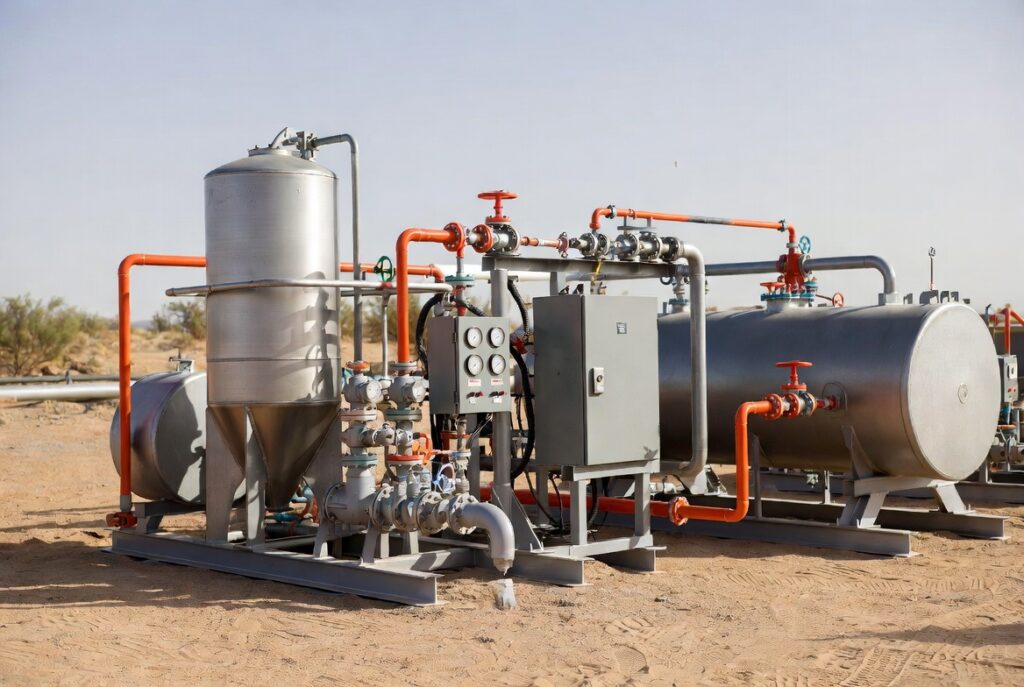
Write a feed envelope instead of submitting one sample
A sample describes the water collected at a particular time and location. State how it was obtained and whether it represents normal production, startup, a workover return or another condition. If several wells feed the package, provide information about the expected mixture and how it changes.
List relevant ranges for flow, temperature, oil, suspended solids, salinity and other parameters identified by the process designer. Include known chemical additions and emulsion behavior where those affect treatment. Unknowns should be recorded as open design inputs rather than replaced with convenient assumptions.
Differentiate normal variation from credible upset conditions. Agree which cases the package will treat continuously, which require reduced throughput and which must be diverted or managed elsewhere. This makes operating limitations explicit while the equipment scope can still be adjusted.
Convert the performance claim into a measurable schedule
| Schedule item | What to define | Ambiguity to avoid |
|---|---|---|
| Feed conditions | Parameter ranges and representative operating cases | A target based on only the cleanest sample |
| Outlet targets | Named parameters, units and applicable quality basis | “Clean water” or an unexplained percentage removal |
| Throughput | Net treated flow and its permitted operating range | Confusing inlet capacity with usable outlet volume |
| Sampling | Locations, timing, handling and agreed analytical methods | Samples that cannot be compared on the same basis |
| Test conditions | Duration, stable operation and permitted adjustments | A brief demonstration presented as campaign performance |
| Exceptions | Feed changes, utility failures and investigation procedure | Unstated exclusions discovered after delivery |
Removal efficiency and final concentration answer different questions. The same percentage removal can leave different residual concentrations when the inlet load changes. If both measures matter, specify both and relate them to the agreed feed envelope. Do not assume that reducing oil or solids also removes dissolved salts.
Specify the acceptance samples and measurements
Agree how inlet and outlet observations will represent the same operating condition. Account for the package's process residence time and any internal storage when planning paired sampling. Identify the laboratory, method, reporting units and procedure for handling disputed or inconsistent results.
Write down who collects samples, labels them and records the operating context. Relevant context can include feed source, flow, chemical additions, filter condition and recent changes in operation. Without these records, a poor result may be difficult to distinguish from a nonrepresentative sample or an actual treatment limitation.
For online instruments, define their role relative to laboratory measurements and specify calibration or verification requirements. An operational indication may be useful for control without serving as the sole contractual acceptance measurement.
Include consumables and waste streams in the promise
A treatment package may meet an outlet target while producing more sludge, backwash or spent media than the site can handle. Record these streams, their expected basis and the customer's handling responsibilities. The performance review should include usable water output and the work needed to manage the residuals.
Ask the supplier to identify consumable assumptions, service intervals and the effect of changing feed load. Where chemical dosing is proposed, agree the operating basis and the method for evaluating consumption during acceptance. An unusually favorable short demonstration should not be extrapolated to all field conditions.
The existing modular produced water selection guide covers the broader equipment decision. Use this guarantee schedule as the next step, once the treatment objective and general process scope are understood.
Separate factory verification from field performance acceptance
Factory checks can demonstrate assembly, selected functions and the agreed mechanical or control tests. They may not demonstrate treatment of the destination's actual water when that feed is unavailable. List what the factory program proves and what remains to be evaluated during site commissioning.
If the package receives water from a mobile well testing operation, coordinate the supply schedule and discharge routes. A test campaign may have changing flow and composition, so steady feed assumptions require particular care.
Before shipment, settle the field trial prerequisites: utilities, representative feed, sampling access, trained personnel, waste handling and supporting records. Define how deviations are investigated and who approves any retest. Avoid automatic acceptance based only on elapsed time when the agreed test conditions have not been available.
Prepare a performance-based request for quotation
Send the water analysis and its sampling context, expected flow range, outlet use, target parameters and site services. Add the proposed acceptance schedule and ask the supplier to identify deviations explicitly. Any uncertainty about the feed or achievable quality should be resolved through engineering review and appropriate testing.
Discuss your treatment performance requirements with Vance Petroleum before selecting the package. A written feed envelope, measurable outlet target and agreed verification method provide a practical basis for comparing offers and deciding whether the proposed treatment scope fits the project.
Continue your equipment research
Compare the equipment pages and technical notes most closely connected to this topic.